Apparently the path to camera upgrades in nest boxes isn't really smooth. When it works, it works really well. It would appear that my squirrel pair are no longer in residence, however I did get a brief visitor earlier today which shows some strengths and weaknesses of this particular webcam
I need to deactivate the wobbly autofocus. This can easily be done with the following command in a linux terminal:
uvcdynctrl -v -d video0 --set='Focus, Auto' 0
I also seem to have run into a problem where it runs for approx 18 hrs then drops off the network. Since at this point I cant SSH into it I cant tell if its still streaming and its a network problem, or whether the Pi has seized up. I'm going to try reducing the resolution and fps and see if that makes it any more stable. I have had this same webcam streaming in HD across my home network with a different Raspberry Pi solidly for several weeks, so I hope I haven't got a dodgy Pi one stuck up a tree now :(
So, as I
mentioned in a previous
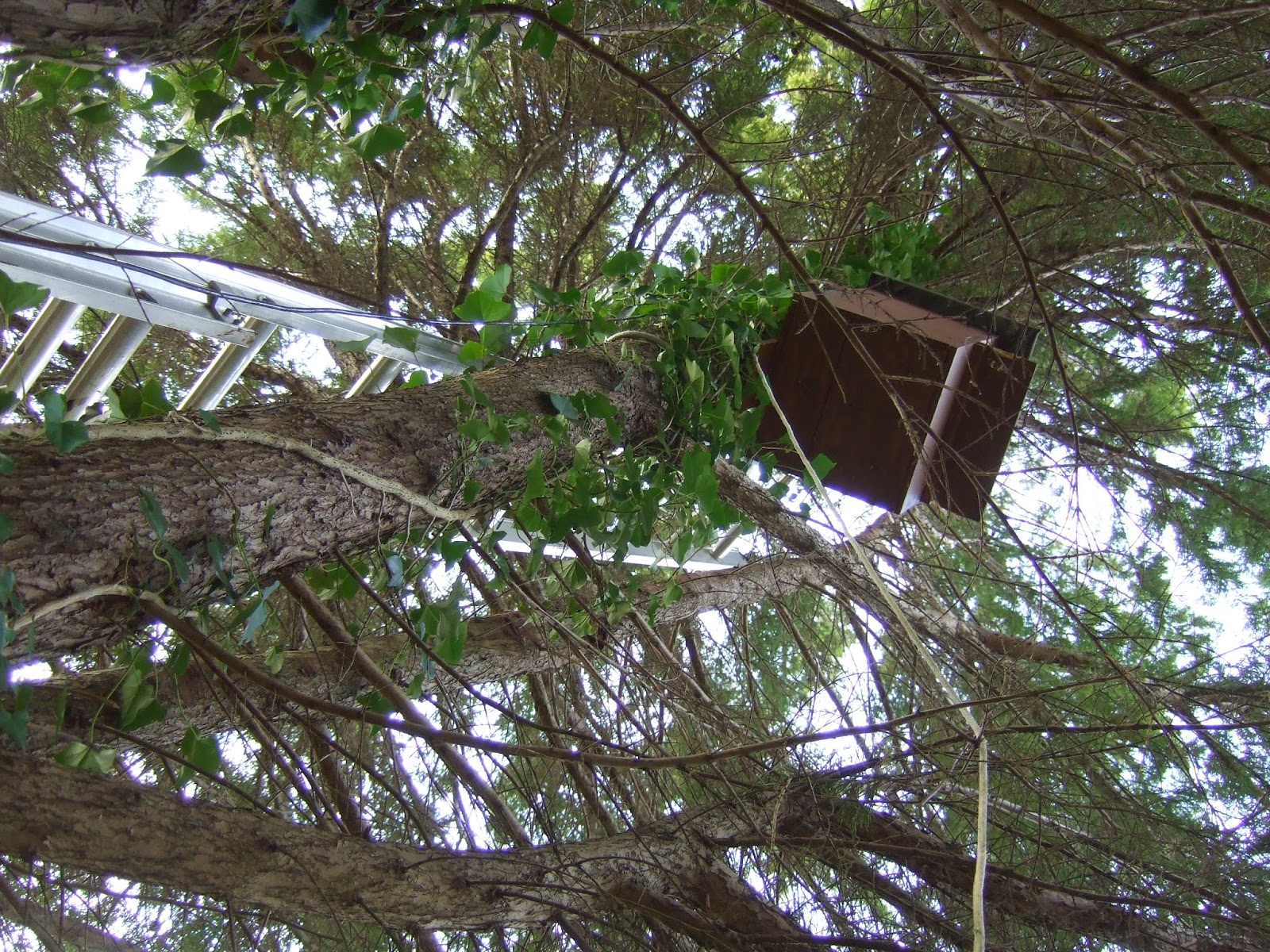
post, my Tawny Owl nesting box has/had some squirrels in it who have done a loft conversion so we now have a squirrel drey - complete with branches sticking out of the entrance hole.
View from below
The camera in
there was really limited in terms of the picture quality, as the a
2.4GHz radio transmission transmitter had very poor performance (read
as mostly non-functional). Today I took
advantage of the lack of wind, and did a
quick and dirty mod, and replaced the existing camera with a webcam-raspberry
pi combo.
I've been
working for a while on a pi-cam nesting box for smaller birds (full post later),
and Iused the same methodology to rig up a webcam in the Owl box. For power, I've used power-over-ethernet
(PoE), so I've only one cable running to it.
The box is
approx 150ft from the house. Last year, I
ran exterior ethernet cable underground most of the way, to a shed which is
approx 30ft from the tree. From the shed
I've run a ethernet cable which takes a power injection using a TPlinkPoE kit, which steps down from 48 to 5v in the nest box. Webcam is a microsoft lifecam cinema. I created all the
network cables from a box stock of exterior cat5e network cable. There's
no artificial lighting in the box as I had to make these changes 20ft up a tree
so had no room for finesse, and plenty of room for falling out of the tree. The old camera had several IR leds (too
many), so unfortunately night vision is
out for now.
Kit in-situ (again no finesse here - mostly chucked in)
In a later
post I'll detail how motion jpeg stream is setup from the Pi, but its cool to
SSH into a linux box
250ft from my desk and 20ft up a tree.
The improvement in quality is immediately obvious. I'll need
to do some repositioning later in the week.
At 800x600
resolution I get approx 20 fps, and at 1280x720 I get 7-10 fps which isnt bad
for full HD. The video signal is a
motion jpeg stream, which is fed to a pc running iCatcher console
software. This sees it as an IP camera
and does the motion capture side of things.
Audio: I haven't investigated this yet, but this webcam has an inbuilt
microphone from which I think it should be possible to grab an audio feed.
Stay tuned for some (hopefully interesting) footage...
I'm interested
in how technology can be applied so that aspects of the environment around us
can be measured, or seen in ways not normally possible. This project is an alternative take on the basic bird-box camera concept.
I've always
had an interest in ornithology, starting from when as a youngster I went out
with Dad and watched sea ducks through a telescope approx 1km away in a force 4
gale. While this might put off some
kids, I think this sort of experience drove a need to get things a bit more
'close up'.
As a
grown-up I've built some basic bird boxes which have invariably been occupied
at one time or another by blue tits & great tits.
Owl box
Last year I started tinkering with camera-enabled bird boxes, and built what I optimistically called my 'owl' nesting box, which was occupied
by a family of great tits - nobody told the local Tawny Owls. This was my first camera-equipped box, which
used acolor 540 line CCD camera, from Handykam. This was linked to a PC video capture card
and video captured using iCatcher software from iCode Systems.
Here is
some footage of a few early interested visitors:
In March
2013, we had great fun as a family watching a family of great tits raise a
brood.
The above video shows some male female courting behaviour. You can tell which one the male is as he has a thicker belly stripe (not evident from this top-down approach!)
9 Great tit eggs
Hungry chicks...
While the video quality started off good, it gradually degraded and is now only works intermittently. While this is a colour camera, I never got colour video. I think this is because I used a very long cable run (30m) combined with a 200 ft wireless transmission distance.
Limitations of this approach
1) Relies
on radio-frequency transmission, with distance transmission issues
2) Is
therefore distance and line-of-site limited
3) Has
problems with interference in poor weather - which as I write (Feb 2014) is
very poor indeed !
4) Interferes
with nearby similar systems - we're a mini-Spring-watch street!
5) No audio
My camera-enabled bird box wishlist
1) Higher
resolution, colour video + audio
2) Not
reliant on "analogue" radio transmission.
3) Single
wire run
4) Compact
5) Preferably
internet-protocol (IP) based
6) Low cost
If cost wasn't an issue, there are various ways to achieve this for example, you could theoretically use a dedicated IP-camera & mic option to monitor nesting activity.
There are many examples out there of internet-enabled wildlife feeds, such as that available for the Peregrines on Norwich Cathedral
Unfortunately,
my budget wont stretch to this! Raspberry-Pi powered birdbox...
I recently
discovered the brilliant low-cost computing system that is the Raspberry Pi. The Pi is a small,
bare-board computer that allows you to do a load of cool stuff for minimal cost.
In this context, by attaching a simple USB webcam to the Pi, and getting creative with some power-over ethernet it is possible to setup a live video stream with one cat5 network cable connected to it.
The following image is a screen capture of a video captured from a high definition USB webcam attached to a Raspberry Pi, powered by power over ethernet, streaming across my home network and motion-captured using iCatcher software.
Squirrel-selfie
Bird box camera plus+ I recently found this video from the University of Manchester School of Computer Science which (amongst other things) shows a Raspberry Pi-powered bird box.
The really neat thing they've done here is that you can count nest box activity, which opens up the option to create plots such as these, and lets be honest, we all like a good graph (well, I do anyway!)
The Raspberry Pi can be theoretically put to other uses in this context, for example adding a temperature sensor, and visualising bird activity with the weather. Anyway, over the next few weeks I'll blog my progress and with luck I'll end up with a high-definition, video streamed video bird box at an affordable cost and have a bit of fun in the process.
Cheers
Chris Update 10/05/14: My take on this design is described in this post Update 10/05/14: Description of entrance hole counter in this post